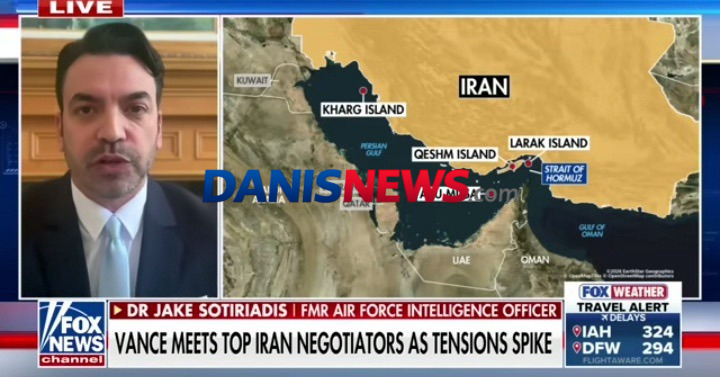
According to a report by Fox News on Sunday, June 21, 2026, a leading security analyst has warned that while recent heavy military strikes have strengthened deterrence against Iran, achieving a lasting peace agreement will require far more than battlefield success, as it involves engaging with a deeply complex ideological and political structure.
Dr. Jake Sotiriadis, a national security strategist, argued that the recent escalation under President Trump has significantly tilted the strategic balance in Washington’s favour. However, he cautioned that any temporary ceasefire or short-term truce should not be mistaken for a complete or permanent resolution of the broader conflict, stressing that the underlying tensions remain unresolved.
He explained that the current situation should be viewed as the early stage of a much longer diplomatic process rather than a final settlement. According to him, there is a clear distinction between an interim agreement aimed at reducing immediate hostilities and a comprehensive peace deal capable of addressing the root causes of the conflict.
“I think we’re talking about apples and oranges in terms of the two different deals right now,” Sotiriadis said, noting that while limited agreements may provide breathing space, they do not necessarily translate into long-term stability. “When you look at where we are at this point, I go back to what I said before is that this is really the beginning of negotiations for a permanent deal.”
Sotiriadis credited the current administration’s aggressive military posture with significantly weakening Iran’s operational capabilities. He pointed to widespread damage inflicted on Iranian military infrastructure, which he said has reduced the country’s ability to conduct both conventional warfare and asymmetric operations across the region.
“President Trump, no doubt, has demonstrated the power of American deterrence,” he stated. “He has weakened Iran’s military considerably, weakened their missile forces, their drone capacity, destroyed the Iranian navy.”
He argued that this military degradation gives the United States and its allies a stronger position in any upcoming negotiations, as Iran enters talks with reduced strategic leverage. He also noted that the implied threat of renewed military action continues to serve as a key bargaining tool for Washington in diplomatic engagements.
“So I think from that perspective the United States does have leverage militarily, and there’s no question that President Trump has put on the table that he would return to military action again if we can’t get to where we need to in the negotiations,” he added.
Despite these perceived military gains, Sotiriadis warned that force alone cannot resolve what he described as a deeply rooted ideological challenge. He argued that Iran operates not merely as a conventional state but as a complex ideological network embedded within political, religious, and institutional structures.
He emphasised that any sustainable strategy must go beyond physical destruction of military assets and instead focus on weakening the internal systems and relationships that sustain Iran’s political ideology and influence.
“But having said that, I think we have to be respectful about what we’re dealing with,” he noted. “Iran itself is not an individual, it’s an ideological power network, and that requires a strategy to actually weaken the elements of that network, the relationship between the population elites and the institutions.”
Looking ahead, he suggested that the current diplomatic window created by the temporary pause in hostilities presents a critical opportunity for a combined approach involving both military pressure and advanced diplomatic engagement. He stressed that success would depend on balancing hard power with strategic negotiation.
“And that is going to require, I think, deft diplomacy backed by hard military power, and we’re going to see how far we can take that,” Sotiriadis concluded. “Hopefully, we can get to some permanent resolution within these next 60 days.”