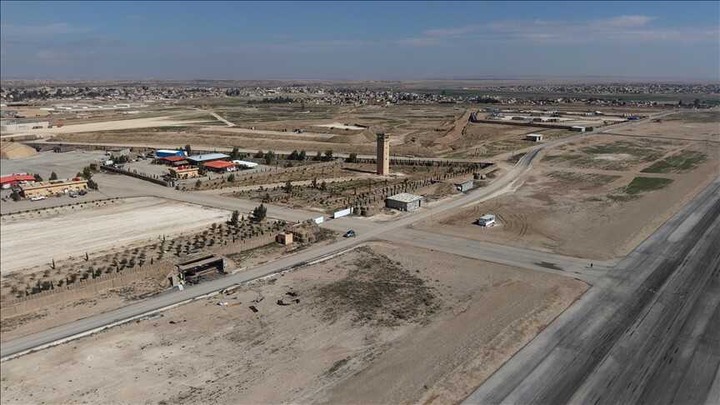
According to a report by Anadolu Agency on Monday, June 1, 2026, a new satellite-based assessment has indicated that Iranian military strikes have damaged at least 20 United States military installations across the Middle East since the outbreak of hostilities involving Iran, the US, and Israel earlier this year.
The findings, drawn from an analysis of satellite imagery and video footage reviewed by BBC Verify, suggest that the affected facilities are spread across several Gulf and regional countries, including Saudi Arabia, the United Arab Emirates (UAE), Qatar, Kuwait, Iraq, Jordan, Bahrain, and Oman.
According to the report, the analysis relied on high-resolution imagery from multiple international satellite providers, including archived datasets from Planet, a commercial imaging company used to verify structural damage and operational disruptions at key military sites.
The assessment claims that Iranian strikes caused varying degrees of destruction at strategic US-aligned military locations, challenging earlier statements from the White House that suggested Iran’s military capabilities had been significantly degraded.
Military analysts cited in the report argue that the scale and precision of the damage observed indicate that Iran’s counterstrikes were more coordinated and impactful than publicly acknowledged by US officials.
Among the most notable incidents highlighted were attacks on three advanced US anti-ballistic missile systems reportedly located at Al Ruwais and Al Sader airbases in the UAE, as well as Muwaffaq Salti Airbase in Jordan.
The satellite imagery further suggested substantial damage at Prince Sultan Airbase in Saudi Arabia, where US surveillance and aerial refueling assets were reportedly affected. Analysts identified burn marks, destroyed hangars, and wrecked aircraft consistent with targeted strikes. One aircraft reportedly seen in the imagery was an E-3 Sentry airborne warning and control system plane, which some estimates place at up to $700 million in replacement value.
Additional sites, including Ali Al Salem Airbase and Camp Arifjan in Kuwait, were also reported to have suffered damage. Defence analysis firms examining the imagery pointed to destroyed fuel storage facilities, damaged aircraft shelters, and impacted troop accommodation areas, suggesting repeated strikes during the conflict period.
At Camp Arifjan, separate intelligence assessments indicated that satellite communications infrastructure was also affected, potentially disrupting operational capabilities.
The broader conflict reportedly escalated following joint US-Israeli strikes on Iran in late February. Iran responded with retaliatory attacks targeting Israeli territory and US-aligned positions across the Gulf region, while also increasing pressure in strategic waterways, including the Strait of Hormuz.
Although a temporary ceasefire was reportedly reached in early April through diplomatic mediation involving Pakistan, subsequent negotiations held in Islamabad failed to produce a lasting settlement.