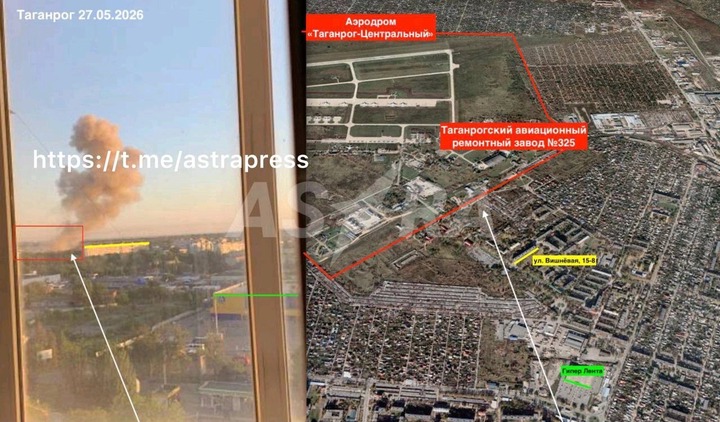
On Wednesday, May 27, 2026, Ukraine launched a new wave of long-range attacks targeting Russian military and energy infrastructure, striking an aircraft repair facility, a major airbase, and an oil refinery in what appeared to be another escalation in the ongoing cross-border conflict.
Russian regional officials said air defense systems were activated across several regions overnight, claiming that incoming drones and missiles were intercepted. Despite those assertions, local reports and videos circulating online showed explosions and fires at multiple strategic sites within Russian territory.
In the Rostov region, Governor Yury Slyusar stated that air defense units shot down a missile over the city of Taganrog. He added that falling debris injured two women, one of whom was seriously hurt. However, independent assessments and footage reviewed by Russian media outlet Astra reportedly suggested that areas near the 325th Aviation Repair Plant in Taganrog were affected by the strike.
The facility is known for servicing several Russian military aircraft, including An-12 and Il-76 transport planes, Su-24 bombers, Su-25 attack aircraft, as well as Mi-8 and Mi-24 helicopters. The plant has previously been sanctioned by the European Union, the United States, and Ukraine because of its role in supporting Russian military operations.
In the Voronezh region, explosions were also reported near the Baltimor military airfield, a base linked to Russia’s Su-34 fighter-bombers frequently used in operations against Ukrainian targets.
Governor Alexander Gusev claimed that air defense systems destroyed two high-speed targets over the region, noting that debris damaged civilian structures but caused no casualties.
Ukrainian monitoring channel Exilenova+ alleged that British-French Storm Shadow cruise missiles were used during the operation. Videos posted online showed thick smoke rising above the airbase area after the reported explosions.
Elsewhere, the Tuapse oil refinery along Russia’s Black Sea coast was reportedly targeted again during the overnight strikes. Eyewitness footage shared by Astra appeared to show activity around the refinery, although the scale of the damage had not been independently verified. Local authorities had not released detailed information at the time.
Occupied Crimea was also reportedly targeted. Russian-installed authorities in Sevastopol claimed that Ukrainian drones and Storm Shadow missiles attacked the city overnight.
Governor Mikhail Razvozhayev stated that one missile struck the Southern Directorate building of Russia’s Central Bank, causing a roof fire and damage to nearby residential buildings, including shattered windows and damaged balconies. No casualties were reported.
Later, Russia’s Defence Ministry announced that its air defense systems had intercepted and destroyed 140 Ukrainian drones across seven Russian regions and occupied Crimea overnight. However, the ministry did not address reports of missile strikes on strategic facilities.
The latest attacks came amid a broader escalation in the war. Over the weekend, Russia launched one of its heaviest aerial assaults on Kyiv in recent months, firing around 90 missiles and more than 600 drones, according to Ukrainian authorities. Officials said the bombardment killed at least four people and injured 87 others.
Following the escalation, Russia’s Foreign Ministry announced what it described as “systematic strikes” targeting Ukraine’s military-industrial infrastructure and what it called “decision-making centers” in Kyiv and other locations. The ministry also urged foreign nationals and diplomatic personnel to leave the Ukrainian capital.
Russian Foreign Minister Sergei Lavrov was also reported to have discussed the matter during a phone conversation with Marco Rubio, suggesting that American diplomatic staff should evacuate Kyiv.
In response, Ukraine’s Foreign Minister Andrii Sybiha dismissed the warnings as “shameless blackmail,” insisting that foreign diplomatic missions would continue operating in Kyiv despite Russian threats.
Meanwhile, Katarina Mathernova also rejected Moscow’s calls for evacuations, reaffirming that European diplomatic missions would remain active in the Ukrainian capital.